
Horizon 2020 — Grant agreement 653676
Proactive Enhancement of Human Performance in Border Control
About
BODEGA’s aim is to develop future border checks with human factors expertise in order to enhance efficiency, border security and traveller satisfaction. The project focuses on the changes to traveller processes and border controller work due to the introduction of smarter border control systems like automated gates and self-service systems based on biometrics. The traveller is one important actor in the entire process and thus also the traveller’s role needs to be carefully considered in the development and implementation of future technologies.
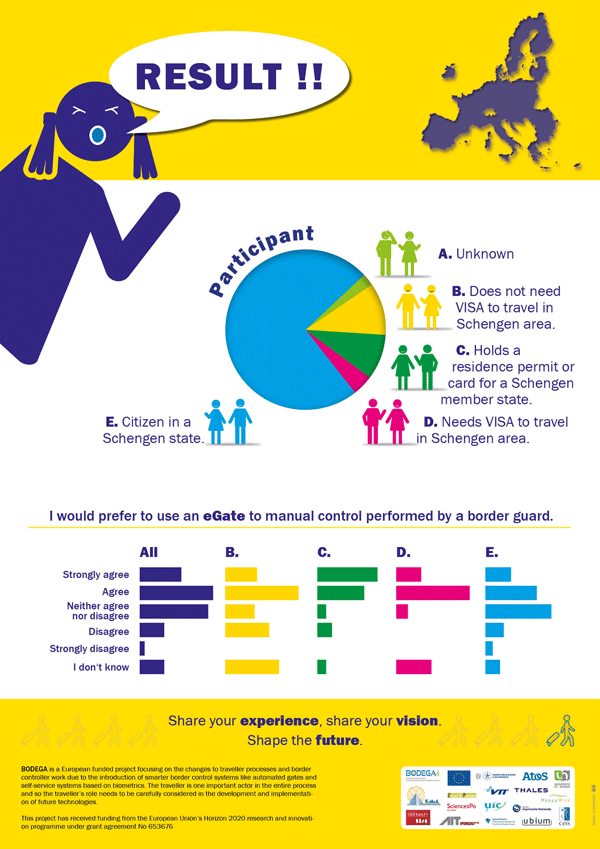
In order to gain better understanding of different aspects of border crossing from travellers’ point of view, we’ve conducted a survey that focuses on travellers’ experience, opinions and perceptions concerning current as well as future border control.
Facts and figures
- Programme
- Horizon 2020
- Grant agreement
- 653676
- Coordinator
- VTT Technical Research Centre of Finland
- Launched
- 10–11 June 2015
- Kick-off
- Tampere, Finland
- Partners
- 16 organisations
Key Results
PROPER Toolbox

Who can use this Toolbox
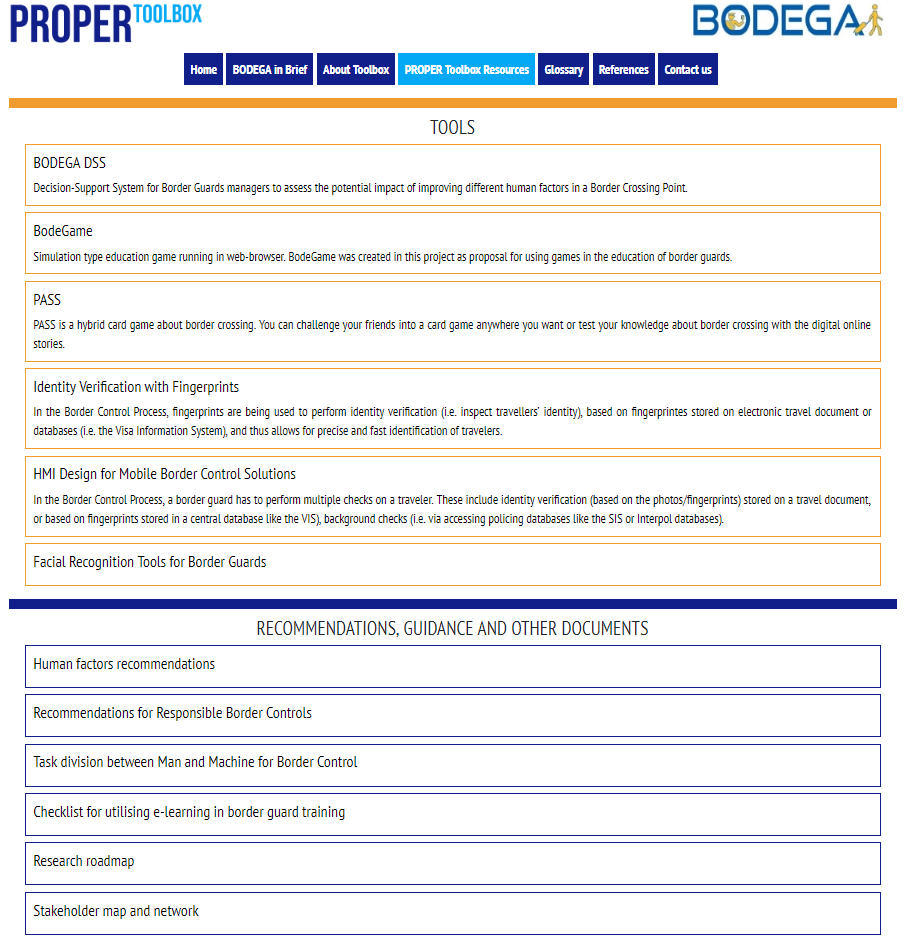
The PROPER Toolbox is an environment created for border authorities, the border technology industry and travellers that offers interactive content for exploring the outputs of the BODEGA project. It is a free, online resource for BODEGA’s key stakeholders to translate and utilise the project’s results into their own operational context.
The PROPER Toolbox Resources can be exploited to support decision-making, enhance the engineering of user-friendly systems and equipment for professional use, improve the working conditions of employees in border management, design next-generation border guard training and educate travellers on border procedures.
The PROPER Toolbox
- provides an overview of the BODEGA project and its core focus points
- publishes the key outcomes of the BODEGA project in a set of tools
- compiles a list of key terminology used within BODEGA research on border control
- suggests a collection of topic-specific literature for further investigation
Further information Veikko IKONEN VTT Technical Research Centre of Finland email: veikko.ikonen@vtt.fi
Travellers survey
Latest news
- 23 October 2018BODEGA consortium participates in a joint conference co-organised by eu-LISA and FRONTEX on 17 October 2018 in Tallinn, Estonia
- 26 April 20166th Edition of Transport Research Arena (TRA) held in Warsaw: UIC demonstrated its know-how and expertise
- 12 April 2016BODEGA – First rail field studies began in Brussels on 8 April!
- 17 November 2015BODEGA end-users workshop held on 12 November 2015 in Brussels
- 20 October 2015UIC meets Frontex within the framework of the Bodega project on 15 October 2015 in Warsaw
- 16 June 2015UIC is partner in BODEGA (BOrdDErGuArd) research project launched on 10 – 11 June 2015 in Tampere, Finland
- 10 February 2015UIC participates in EU Programme Horizon 2020
Press releases
Consortium
Partners
- VTTVTTVTT Technical Research Centre of Finland
- CEACEACEA LIST (France)
- AITAITAIT Austrian Institute of Technology GmbH
- UNamurUNamurUniversity Of Namur (Belgium)
- ATOSATOSAtos (Spain)
- ThalesThalesThales Communications & Security (France)
- CEISCEISEuropean Strategic Intelligence Company (CEIS) (Belgium)
- Z&PZ&PZanasi & Partners (Italy)
- UICUICInternational Union of Railways (UIC) (France)
- ADMADMAgenzia delle Dogane e dei Monopoli (ADM) (Italy)
- KEMEAKEMEACenter for Security Studies (KEMEA) (Greece)
- RAJARAJAThe Finnish Border Guard (RAJA) (Finland)
- UbiumUbiumUbium (Finland)
- HappyWiseHappyWiseHappyWise (Finland)
- CEVIPOFCEVIPOFCEVIPOF (Centre for Political Research) - Sciences Po Paris (France)
- ININGroupe Imprimerie Nationale (France)
Project structure
General Structure
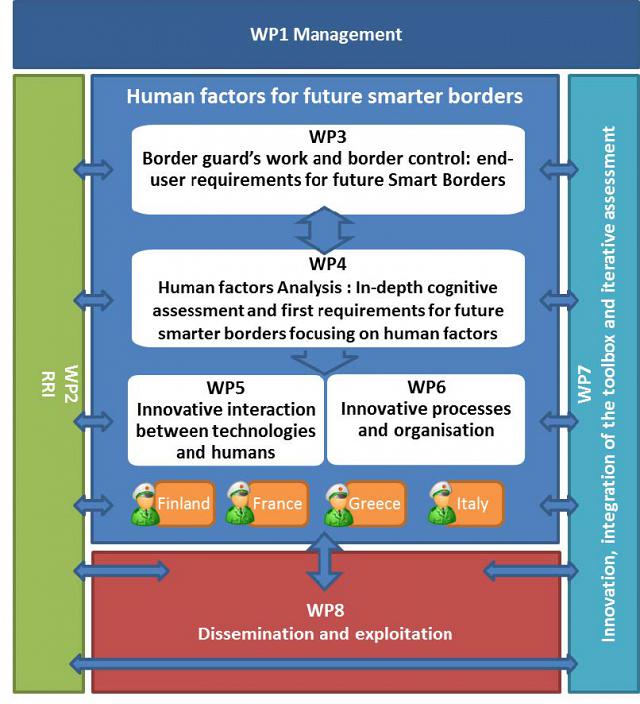
WP1 - Management (led by VTT)
WP1 focuses on the day-to-day management tasks of the BODEGA project, ensuring that it stays on track, and that all planned deliverables are met.
WP2 - Responsible Research and Innovation ( led by University of Namur)
WP2 will develop a Responsible Research and Innovation (RRI) framework for the BODEGA project. The framework will be integrated into other work packages Work Package 2 creates an analytical overview of existing approaches to the consideration of human factors in border control. Particular attention will be paid to the integration of ethical and societal issues in order to clarify a clear mapping of possible areas for innovation and unclear problems.
WP3 - Border guard’s work and border control: end-user requirements for future Smart Borders (led by VTT)
WP3 will produce an understanding of the human factors and motivational issues of border guard’s work and border control tasks. The physical, organisational and technical environment will be taken into account. This understanding will be mainly achieved thorough field studies in which border guard work is observed and studied by interviewing different stakeholders including border guards, decision makers and passengers. The field studies will be carried out at several air, sea and land borders.
The objectives are :
- Construct an understanding of the human factors and motivational issues of border guard’s work and border control tasks,
- physical,
- organisational
- technical environment
- Collect, analyse and synthesise human factor -needs and requirements
- Smart Borders
- Smarter solutions
- Automated border control.
- Provide input to PROPER toolbox
- Repository of human factors requirements
- Field study methodologies
- Task models
WP4 - Human factors Analysis : In-depth cognitive assessment and first requirements for future smarter borders focusing on human factors (led by CEA)
In WP4, the data from WP3 will be organized within task models to deliver a comprehensive picture of the human factors at border crossing. Work package 4 will also process the data gathered in WP3 for an in-depth inquiry of skills and effective abilities of border controllers implied during border control. The study will focus on cognitive processes implied during document verification, identity verification and more particularly to perception strategies and attention (for example face recognition), situation awareness and decision making. WP4 will provide first requirements for smarter borders regarding human factors.
The objectives are
- Build Task models from cognitive task analysis performed in WP3 to be used in WP5 and WP6 for
- Document verification
- Identity verification
- Background data based risk analysis (Information systems used by borderguards)
- Video based risk analysis
- ABC: interaction with border guards
- HM Interfacing operating a mobile device when a passenger is checked at a border : traveller’s point of view, gamification and e-learning, decision support systems
- Provide an in-depth literature inquiry about :
- The human factors addressed at borders in light of the cognitive task analysis in Processes implied in identity and document verification, (perception and attention, situation awareness, decision making, vigilance …
- Human-machine Task allocation in complex systems; lessons learned from other field domains like air traffic control or industrial and nuclear power plants
- Organizational issues (shifts, collaborative work)
- Provide first requirements for smarter borders regarding human factors.
WP5 - Innovative interaction between technologies and humans (led by Thales)
Based on WP2, WP3 and WP4 findings, WP5 will concentrate on the border control task allocation between human and machine. It will propose innovative interaction between humans and technologies. The study will focus on traditional duties like document verification, identity verification and risk assessment on the travellers. WP5 will produce recommendations based on studies and/or mock-ups to simplify the border guard’s operational mission. These recommendations will be integrated into the PROPER toolbox. In relation with WP7 this output will be used to evaluate how the different concepts are working.
The objective is to provide recommendations on innovative interaction between technologies and humans for
- Document verification
- Identity verification
- Data based risk analysis
- Video based risk analysis
- ABC: interaction with the border guard
- HMI using mobile device Multi-modal biometric enrolment and identification systems, identity documents issuance
WP6 - Innovative processes and organisation (led by ATOS)
WP6 will take advantage of WP2, WP3 and WP4 findings, and incorporate those into processes that are part of the rail, road, maritime and air border control activities. The study will take into account processes from both travellers and border guards’ points of view. Work package 6 will also investigate mid and long-term decision making processes in regard to the border controls for the different environments. Innovative game and e-learning solutions will be designed and piloted.
The objectives are
- Facilitate control processes to travelers
- Establish clear and explicit guidelines for enhancing travelers cooperation, of the border control processes, increasing effectiveness of the border crossing process from the travelers point of view
- Strengthened border control staff capabilities
- Establish of homogenous, best practices of training, organizing, managing and skill and knowledge maintenance for the border control staff
- Improved decision-making process:
- Definition of key factors to be included in mid- and long-term decision-making processes
- Guidelines for decision support systems to be used in smart borders
- Demonstration:
- Demonstrating innovative gaming and e-learning solutions for border control (e.g. for training, traveler experience)
WP7 - Innovation, integration of the toolbox and iterative assessment (led by CEIS)
WP7 will gather end users’, border management decision-makers, border guards and travellers’ representatives, inputs and assess the results of the project iteratively. The work package will start with identifying the various stakeholders on EU border control and security from policy makers to industry to researchers in previous border control projects, to create a network for facilitating the exchange of best practices and for co-developing the Toolbox. Then Work package 7 will integrate the validated results as a toolbox and create a network of stakeholders and facilitate the exchange of best practices between end-users, researchers and the academic and scientific community.
The objective of this work package are
- Build up a comprehensive stakeholder map and a network for the gathering end users’ - border management decision-makers, border guards and travellers’ representatives - inputs and assessing the results of the project relying on an iterative feedback process in different phases of the project.
- Create a network of stakeholders and facilitating the exchange of best practices between end-users, researchers and the academic and scientific community and related projects conducted in the framework of FP7 and, if applicable, H2020. This will be done in workshops but also through private internet workspace accomplished in WP8.
- Ensure and show in measurable terms that the results developed in earlier work packages will of high quality for end users and with regards to innovativeness and applicability in border control. This aim will be achieved by designing a common methodology and criteria for measuring the success of the results and arranging validation and evaluation actions through a number of end user workshops and iterative co-design activities.
- Collect the validated results in a toolbox - PROPER Toolbox – to promote taking the results into use for the benefit of border control and the work of border guards. The Toolbox will be carefully validated as well with different users and stakeholders.
WP8 - Dissemination and Exploitation (led by Zanasi & partners)
WP8 manages the dissemination of the knowledge generated and the results achieved during the whole project duration. The work carried out in WP8 is intended to generate awareness of the BODEGA project across any interested stakeholder, including border control authorities, law enforcement agencies, experts in privacy and ethical issues, psychologists, artificial intelligence practitioners, manufacturers of border control technologies (both hardware and software), teaching and training institutions, governmental and enterprise decision-makers.
Deliverables
Presentations delivered in international conferences
Press Releases
Further documents
Past events
- 17 October 2018BODEGA participated to the eu-LISA and Frontex joint conference "EU Borders – Getting Smarter Through Technology” .Tallinn, Estonia
- 25 September 2018VTT participated to the European Association for Biometrics (EAB) Research Project Conference 2018Darmstadt, Germany
- 23 August 2018RAJA attended a meeting organised in the context of Frontex’s Interoperability Assessment ProgrammeTurku, Finland
- 28 June 2018The BODEGA project was represented at the FLYSEC Final Event and EU security research projects cluster meetingBrussels, Belgium
- 26 – 29 June 2018VTT and AIT participated to the 2018 edition of the European Intelligence and Security Informatics Conference (EISIC), where they presented two different papers based on BODEGA’s research findingsLondon, UK
- 25 – 27 June 20182nd BODEGA Project Showcase - SDW Conference and Exhibition 2018QEII Centre, London, UK
- 25 – 26 May 201812th International Scientific Conference SIE2017Rezekne, Latvia
- 19 – 21 April 2018BODEGA co-working days on the road.St Petersburg, Russia
- 16 – 19 April 2018Transport Research Arena 2018 (TRA 2018)Vienna, Austria
- 19 – 23 March 2018Date 18Dresden, Germany
- 06 – 07 February 201821st European Police CongressBerlin, Germany
- 15 December 2017BODEGA eGates field studies conducted at border-crossing points in Belgium, Finland and Greece in 2017
- 07 – 08 December 2017BODEGA - Workshop on Future Border Control - Toward Smart Human / Machine Task AllocationParis, France
- 27 – 28 November 2017UNECE Working Party on Railway TransportGeneva, Switzerland
- 16 November 2017COLPOFER 67th General AssemblyVienna, Austria
- 14 – 15 November 2017Security Research, Innovation and Education Event (SRIEE) 2017Tallinn, Estonia
- 26 October 201724th UITP Security Commission MeetingPrague, Czech Republic
- 26 October 2017International Conference on Applied Psychology and Educational sciencesIasi, Romania
- 17 – 18 October 2017Eu-LISA Annual Conference2017Tallinn, Estonia
- 18 September 2017EAB Research Project Conference (EAB-RPC)Darmstadt, Germany
- 21 July 2017AHFE conferenceLos Angeles, California
- 12 July 2017EAB Biometrics in Aviation seminarLisbon, Portugal
- 07 June 2017Test of the card gamePielisen Museo of Lieska, Finland
- 18 – 19 May 2017Joint Exploitation EventParis, France
- 02 – 05 May 2017Joint Showcase Event of ABC4EU and BODEGA-projectsLevi, Lapland
- 02 – 05 May 2017Joint BODEGA-ABC4EU Showcase 2-5 May 2017 in Levi, FinlandLevi, Finland
- 18 – 19 January 2017BODEGA End-users Workshop 3: Digital transformation in Border Control - Impact on Border Guards’ Work & trainingMadrid, Spain
- 04 – 07 October 2016BODEGA Air, Maritime and Road Field studies in Greece.Greece
- 26 – 29 September 2016BODEGA Rail and Road Field studies in Poland.Poland
- 29 June 2016BODEGA End-users Workshop 2 : Human requirements for future Smart Borders.Brussels, Belgium
- 02 June 201611th World Congress on Railway Research (WCRR)Milan, Italy
- 19 April 2016Transport Research Arena 2016 (TRA 2016)Warsaw, Poland
- 08 April 2016BODEGA Rail Field studies with the Belgian PoliceBrussels, Belgium
- 12 November 2015BODEGA End-users Workshop 1Brussels, Belgium
- 08 October 2015eu-LISA annual conferenceTallinn, Estonia
- 08 July 2015BODEGA first Air Field visit in FranceParis, France
- 10 – 11 June 2015BODEGA kick-off meetingTampere, Finland
Videos
Left object (v1)
The video shows an example for video based risk analysis, developed by AIT and tested within the FP7 FastPass project. It shows the application of real-time algorithms used to detect lost or suspicious items in an controlled area (e.g. an eGate). The experiences made during the projects helped AIT to better understand the needs by border guards and travelers, culminating in human factor recommendations for video based systems within the BODEGA project.
Mobile identity management (v4)
The video shows a first version of the handheld mobile border control device developed by AIT within the FP7 MobilePass project. The work done in this project proved as a good basis to develop new human factor recommendations for mobile border control within the BODEGA project. Furthermore, a new version of the device implementing some of these recommendations, with improved ergonomics (e.g. housing) and a more user friendly UI, has been developed.
Person separation (v1-1)
The video shows another scenario in which video based technologies can help the work of border guards and shows person tracking and person separation for detecting multiple persons within an controlled area (e.g. an eGate). The technology was developed by AIT and evaluated within the FP7 FastPass project. Again, the experience made within has been reflected in the human factor recommendations for video based systems within the BODEGA project.
Queue length (v1-1)
The video shows how video based technologies can help border authorities or (air) port operators to better manage longer queues, in order to allow for a smooth and hassle-free border crossing of travelers. The technology shown in the video has been previously developed and tested by AIT. The findings and experiences gained in this context were in turn incorporated into the recommendations of the BODEGA project.
ProFace: Facial recognition tool.
ProFace is a tool available in first line suitable for all border crossing point. It is integrated with the current environment of border guards (document information received by the scanner reader and data based results). ProFace give all the inputs to the border guards to let them take the right decision about a traveler. ProFace is useful to detect look alike and also to take a decision for a child thanks to an ageing feature. Copyright: Thales
Links and related projects
EU stakeholders and decision-makers
- European Border and Coast Guard Agency (Frontex)
- European Border and Coast Guard Agency (Frontex) - http://frontex.europa.eu
- Partner border control authorities - http://frontex.europa.eu/partners/national-authorities/
- European Commission - http://www.consilium.europa.eu/en/home
- EU Internal Security Committee (COSI)
- Strategic Committee on Immigration,Frontiers and Asylum (SCIFA)
- Frontiers Working Party JAI-RELEX
- Working Party (JAIEX)
- Working Party on Integration, Migration and Expulsion
- Schengen Evaluation Working Party
- CCWP (Council Customs Cooperation Working Party)
European border control authorities and law enforcement agencies
- Polizei — Austria — http://www.bmi.gv.at
- Police/Politie — Belgium — http://www.polfed-fedpol.be
- Гранична полиция — Bulgaria — http://www.mvr.bg
- Police — Cyprus — http://www.police.gov.cy
- Služba cizinecké a pohraniční policie — Czech Republic — http://www.policie.cz
- Politi — Denmark — http://www.politi.dk
- Politsei-ja Piirivalveamet — Estonia — http://www.politsei.ee
- Finnish Border Guard — Finland — http://www.raja.fi
- Finnish Ministry of the Interior (Ministry for Internal Security) — Finland — http://www.intermin.fi
- Police Aux Frontières — France — http://www.interieur.gouv.fr
- Bundespolizei — Germany — http://www.bundespolizei.de
- Ελληνική Αστυνομία — Greece — http://www.minocp.gov.gr
- Λιμενικό Σώμα — Greece — http://www.yen.gr
- Rendőrség — Hungary — http://www.police.hu
- An Garda Síochána — Ireland — http://www.garda.ie
- Agenzia delle Dogane e dei Monopoli — Italy — http://www.agenziadoganemonopoli.gov.it
- Carabinieri — Italy — http://www.carabinieri.it
- Corpo Forestale dello Stato — Italy — http://www.corpoforestale.it
- Guardia Costiera — Italy — http://www.guardiacostiera.it
- Guardia di Finanza — Italy — http://www.gdf.gov.it
- Polizia di Stato — Italy — http://www.poliziadistato.it
- Valsts robežsardze — Latvia — http://www.rs.gov.lv
- Valstybės sienos apsaugos tarnybos — Lithuania — http://www.pasienis.lt
- Police Grand Ducale — Luxembourg — http://www.police.public.lu
- Border Control Services — Malta — http://www.pulizija.gov.mt
- http://www.agm.gov.mt
- http://www.customs.gov.mt
- Koninglijke Marechaussee — The Netherlands — http://www.defensie.nl/marechaussee
- Politi — Norway — http://www.politi.no
- Straż Graniczna — Poland — http://www.strazgraniczna.pl
- Serviço de Estrangeiros e Fronteiras — Portugal — http://www.sef.pt
- Politia de Frontieră Română — Romania — http://www.politiadefrontiera.ro
- Úrad hraničnej a cudzineckej polície — Slovakia — http://www.minv.sk
- Policija — Slovenia — http://www.policija.si
- Cuerpo Nacional de Policía — Spain — http://www.policia.es
- Guardia Civil — Spain — http://www.guardiacivil.es
- Kustbevakningen — Sweden — http://www.kustbevakningen.se
- Polisen — Sweden — http://www.polisen.se
- The Swiss Border Guard — Switzerland — http://www.ezv.admin.ch
- Border Force — United Kingdom — http://www.gov.uk/government/organisations/border-force
Related European projects
ABC4EU: Automated Border Control Gates for Europe
- Description: ABC4EU stands for Automated Border Control Gates for Europe. It is an EU wide project and involves a Consortium of 14 partners from 7 different countries, with a budget of 16,8 Million Euros, 70% EU funding. The aim is to make border control more flexible by enhancing the workflow and harmonizing the functionalities of Automated Border Control (ABC) gates, which are only one example of automation.
- Link: http://abc4eu.com/
FastPass
- Description: FastPass is an integrated project funded by the European Commission under its Seventh Framework Programme (FP7). The project is designed to establish and demonstrate a harmonized, modular approach for Automated Border Control (ABC) gates. Border control is a key factor for guaranteeing mobility and security within the European Union; it has to comply with very different - when not opposite- kind of demands: privacy-compliant, quick, accessible and easy to use border crossing process for the travellers; secure, precise, highly reliable system able to detect several kind of threats by border crossing (piggybacking, counter-spoofing...) for the border guards. FastPass should provide an answer to these expectations and therefore develop an innovative solution centered on the end-users requirements, fully respecting the Data Protection concerns and innovating beyond state-of-the-art technologies for more efficiency. The final system will be then tested at the three type of borders: air (Vienna Airport, Austria), land (Moravita’s border crossing point, Romania) and sea (Greece) to assess its transferability to the market. FastPass will produce a harmonised border crossing solution, a modular system for land, air and sea borders, a highly reliable and privacy compliant architecture, and an improved, innovative user interface.
- Link: [https://fastpass-project.eu/]
MobilePass
- Description: MobilePass is a FP7 research project, which started in 2014. Over 2 years, the MobilePass Consortium focused its efforts on developing a technologically advanced mobile equipment for the land border crossing points. This new device enables border control authorities to check European, visa-holding and frequent third country travellers in a comfortable, fast and secure way. The mobile solution incorporates new technologies needed in mobile scenarios and embeds them in the actual border crossing workflow to speed up control procedures.
- Link: [http://mobilepass-project.eu/]
Protect: Pervasive and UseR Focused BiomeTrics BordEr ProjeCT
- Description: Protect is a 3-year EC H2020 project commenced on September 1st, 2016 and funded under the Secure Societies work programme. The project aims at building an advanced biometric-based person identification system that works robustly across a range of border crossing types and that has strong user-centric features. Additional objectives of the project are to: • Research current and emerging biometric technologies and methods for promising alternative technologies to those mandated by ICAO in order to break the constraints presented by those modalities; • Prototype concepts developed as a result of PROTECT research in a safe and controlled environment but using real locations with live subjects – to prove their security, accessibility and acceptability; • Offer the research, specifications and experience from the prototypes to European border and law-enforcement agencies, to European technology suppliers, having first established the legal and social propriety of such initiatives.
- Link: [http://projectprotect.eu/]
iBorderCtrl: Intelligent Portable Control System
- Description: iBorderCtrl is an innovative project that aims to enable faster and thorough border control for third country nationals crossing the land borders of EU Member States (MS), with technologies that adopt the future development of the Schengen Border Management. iBorderCtrl includes software and hardware technologies ranging from portable readers and scanners, various emerging and novel subsystems for automatic controls, highly reliable wireless networking for mobile controls, and secure backend storage and processing. One of the main goals of the project is to design and implement a comprehensive system that adopts mobility concepts and consists of a two-stage-procedure, designed to reduce cost and time spent per traveller at the border crossing station. iBorderCtrl also focuses on the land border crossing points: road, walkway, train stations. It addresses the better facilitation of thorough checking required for third country nationals that intend to cross EU borders.
- Link: [https://www.iborderctrl.eu/]
TRESSPASS: robusT Risk basEd Screening and alert System for PASSengers and luggage
- Description: TRESSPASS is a H2020 42-month Innovation action project that covers air, maritime and land (including car and train) border crossing points, and specifically travel routes that combine different modalities. With regards to threats, this includes smuggling, irregular immigration, cross border crime, and terrorism, including threats to the transport itself. TRESSPASS will: • develop a single cohesive risk-based border management concept; • develop three pivoting pilot demonstrators: Schiphol Airport, Polish Land Border at External EU crossing control point and Port of Piraeus; • demonstrate the validity of the single cohesive risk-based border management concept by using red teaming and simulations; • prepare for the further development of this concept beyond this project by linking to other known risk-based border management projects (in- and outside EU, within EU research frameworks and on national levels), and describe how their results contribute to a single cohesive risk-based border management concept.
- Link: [https://www.tresspass.eu/]
European Smarter Borders Forum
Link LinkedIn - European Smarter Borders Forum
Objective of the ESBF forum The objective of the European Smarter Borders Forum is to foster exchanges of ideas among border management professionals, academics and the industry in the context of the discussions on the Smart Borders package at the EU level.
The forum will become a platform for knowledge exchange and discussions on topics pertaining to smart borders, border management decision-making processes and optimisation of travellers’ performance. It also intends to facilitate relations among European border management professionals by allowing them to share best practices as well as relevant pieces of news such as events, studies and press articles.
Target audience of the ESBF forum:
Border Guards, Border Guards’ Managers, Customs, Police, Travellers’ Representatives and other stakeholders impacted by the implementation of the Smart Borders.
Legal terms
Acceptance
The use of the BODEGA project’ website implies full acceptance of the following terms and conditions.
Intellectual property
All trademarks and logos displayed on the website www.bodega-project.eu are the property of the International Union of Railways (UIC) and protected by the intellectual property laws applied in France. They may not be used or copied in any way without prior and express permission from the International Union of Railways (UIC), which reserves the right to prosecute any act infringing its intellectual property rights.
The BODEGA project provides links to third-party and external websites, for which it disclaims any responsibility. The insertion of these links does not in any way imply the approval of or an existing partnership with any of these sites. In no event shall the BODEGA project be held liable for the referencing of these sites on its website. The insertion, on external sites, of hyper links to the BODEGA project’ website is subject to prior and express permission from the BODEGA project.
The BODEGA project consequently assumes no liability for the content or the use of:
- Sites linked to from the BODEGA project’ website
- Sites containing a link to the BODEGA project’ website
Security
It is the responsibility of all Internet users consulting the BODEGA project’ website to avoid infecting the site with viruses of any description.
The BODEGA project assumes no liability for any direct or indirect damages arising from access to or use of the site www.bodega-project.eu or the information contained on it.
Personal information
Personal information obtained via the discussion forum on the BODEGA project’ website may not be used for purposes other than to contribute to the proposed discussion topics.
A moderator may change or remove, prior to its being displayed on the discussion forum, any posting that is irrelevant to the topic addressed or that is unlawful.
Users have the right to access, change, correct or remove any of their personal information (as provided for by Article 34 of the French Data Protection Law of 6 January 1978). Users may ask for their comments on the discussion forum to be removed at any time by sending a message to webmaster@nextstation2015.com or by writing to UIC – Legal Department, 16 rue Jean Rey, 75015 Paris.
Site access
The International Union of Railways (UIC) reserves the right to suspend, interrupt or change the site access hours without prior notice.
The hardware required to connect to the Internet, as well as any costs associated with consultation of the site, shall be borne exclusively by the Internet user.
Legal compliance
The BODEGA project’ website has been created and edited in compliance with the laws applied in France. In accessing this website, Internet users resident outside France shall ensure that they are in compliance with the locally-applicable legislation relating to the use and content of this website.
Liability
The BODEGA project assumes no liability whatsoever for any direct or indirect damages arising from the use, access or inability to access the BODEGA project’ website. Neither shall the BODEGA project be held liable for the risks related to the completeness, accuracy, suitability or topicality of the information.
The costs and expenses incurred by the BODEGA project due to any request resulting from the user’s breaching the present terms of use or in relation to the user’s site use shall be assumed exclusively by the user.
Other information
The website’s content management system software is SPIP.
The site www.bodega-project.eu is hosted on the UIC’ server hardware.
Amendments to the terms and conditions of use
The International Union of Railways (UIC) reserves the right to amend the present terms and conditions of use without prior notice. It is users’ responsibility to consult the terms and conditions on a regular basis.
Credits
Editor:
International Union of Railways (UIC) 16 rue Jean Rey 75015 Paris
Publication/hosting:
International Union of Railways (UIC) 16 rue Jean Rey 75015 Paris
Contact
Coordinator Veikko IKONEN VTT Technical Research Centre of Finland Human-Driven Design and System Dynamics Tekniikankatu 1, 33720 Tampere FI-33101 TAMPERE email: Veikko.Ikonen@vtt.fi
Website content Marie-Hélène BONNEAU UIC 16, rue Jean Rey 75015 Paris France email: bonneau@uic.org